Gravity
We don't think about it, but our bodies evolve in gravity. Our muscles allow us to fight against it. Lifting an arm, walking, and bringing a fork to our mouth involves a constant struggle against gravity.
On the other hand, this struggle allows us to maintain our muscle mass. Each movement to overcome gravity generates a cascade of events (release of chemical messengers) inside our body that helps support and develop our muscle mass. In more scientific terms, it is the primary mechanical stimulation essential to our survival.
As soon as gravity disappears, our body no longer receives any stimulation. Without it, the cascade of events stops. Our muscles no longer receive the message that tells them they must adapt. They lose their building blocks: proteins. In other words, we lose our muscle mass.
Muscle atrophy
To avoid muscle atrophy, astronauts must train in space for two hours daily. Exercise equipment is used to put the muscles under resistance. It stimulates them and reawakens this cascade of events necessary for muscle growth.
However, when an astronaut trains for two hours a day, it must be understood that his muscles remain for 22 hours in an environment without stimulation. In these conditions, training only serves to compensate.
Inevitably, in space, the muscles lose their capacity. Their volume and efficiency decrease, also considerably reducing their fitness level.
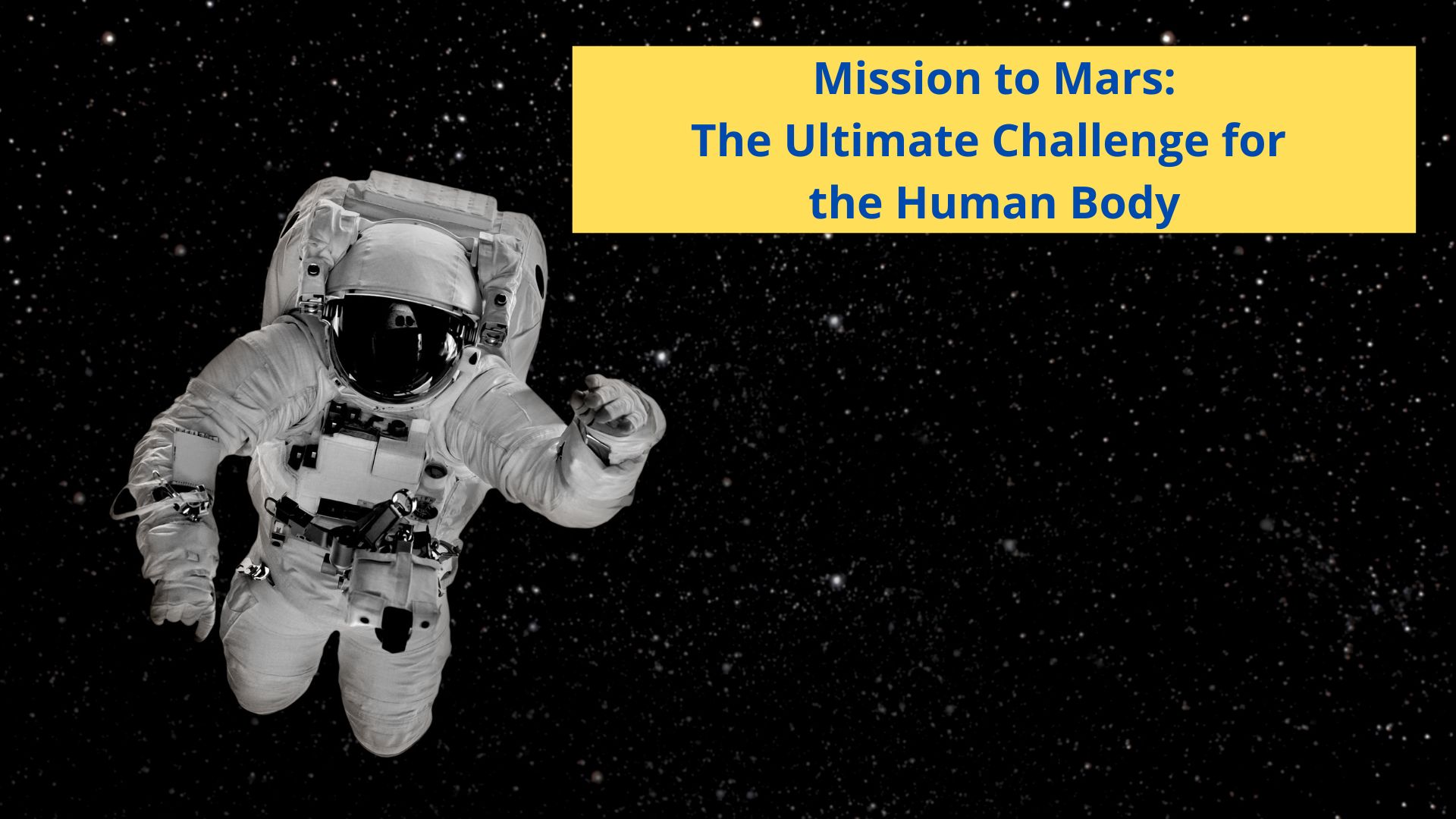
The first mission to Mars will significantly challenge the human body. It will take months to get to Mars and back to Earth, plus the time spent on Mars.
The astronauts will spend many months in an environment that favors muscle atrophy. That's why the search for countermeasures to this phenomenon is of paramount importance.
Click to play
Strength Training
We know that fighting gravity is essential to maintaining muscle mass. We also understand that strength training promotes muscle development by providing mechanical stimulation and causing the metabolic stress necessary to trigger the cascade of chemical messengers leading to muscle mass development. This development results in the accumulation of protein in the muscles.
When the construction of muscle proteins (anabolism) equals their destruction (catabolism), the muscle mass remains stable.
Muscle mass is lost when the destruction of muscle proteins is more significant than their construction. This occurs in space or when a person is sedentary.
A gain in muscle mass is present when the building of muscle protein outweighs its breakdown. So, increasing muscle protein buildup is an option. The option is to reduce muscle protein breakdown while maintaining protein buildup stability. The last option is to increase muscle protein synthesis while reducing its rate of destruction.
To solve the problem that astronauts will face, the ideal would be to recreate gravity in space. However, this will not happen during the first mission to Mars. There is still training, but there will be a better solution.
The fascinating question
So, how do we solve this problem? We know what to do on Earth. Move and exercise. In space, training is used to compensate, but there are many hours in zero gravity without mechanical stimulation.
You will understand I do not have the answer to this fascinating problem. But we already know a lot about muscle development. Muscles need mechanical stimulation and metabolic stress (obtained from training and gravity) to remain stable or grow.
The fascinating question I've been asking myself for years is: is it possible in zero gravity to lure the body into believing it is undergoing mechanical stimulation?
In other words, how can we trigger the cascade of events that stimulate muscle development without using gravity or training?
I don't have the answer yet, but you must admit it's an exciting research topic.